Introduction
In today’s digital landscape, software development security is no longer optional — it’s a fundamental necessity.
With the increasing frequency of cyberattacks, data breaches, and ransomware incidents, developers must prioritize security from the very first line of code.
Neglecting security can lead to severe financial losses, reputational damage, and legal consequences. This article explores the most common vulnerabilities in software development and provides actionable strategies to prevent them.
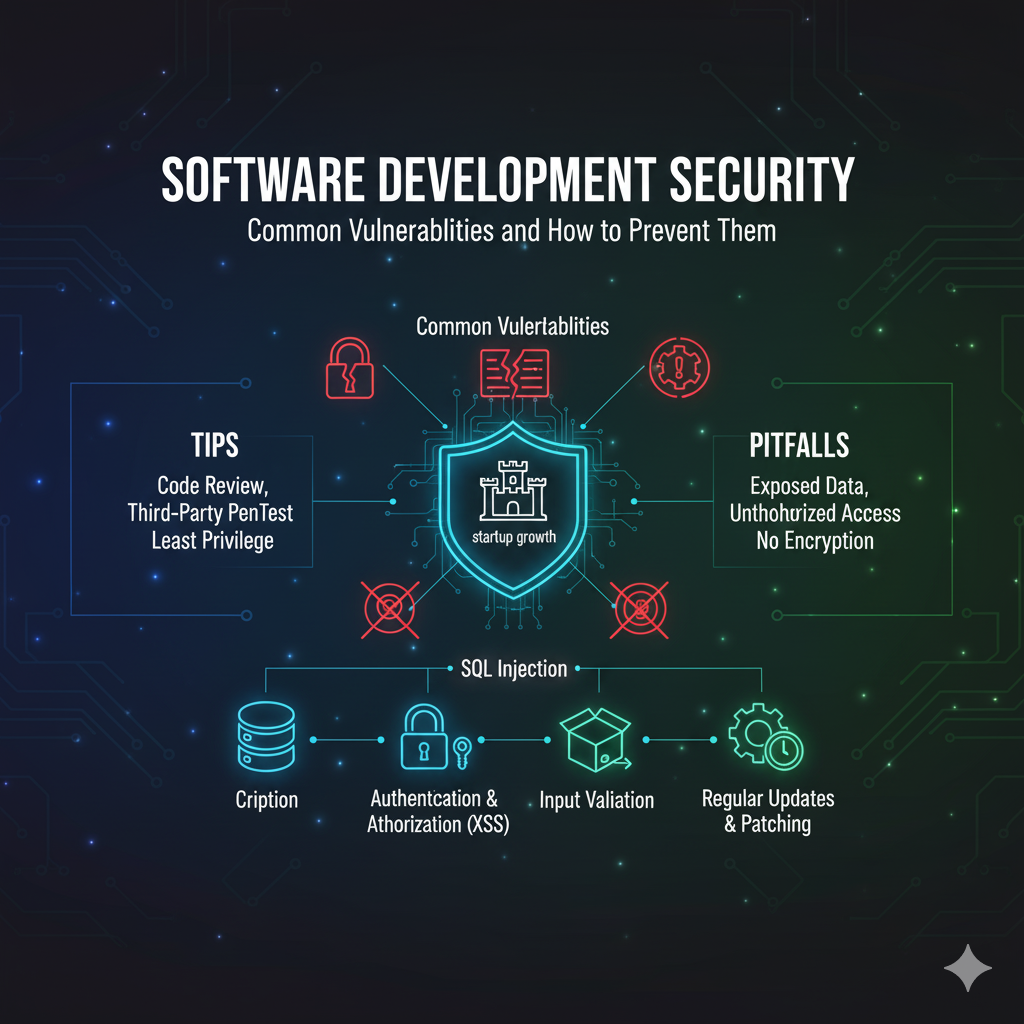
1. Understanding Software Development Security
Software development security refers to the process of integrating protection mechanisms throughout the software lifecycle — from planning and design to deployment and maintenance.
Instead of treating security as a post-production fix, it should be “built-in, not bolted-on.”
The goal is to reduce attack surfaces, safeguard sensitive data, and ensure compliance with standards like OWASP, ISO/IEC 27001, and GDPR.
2. Common Software Vulnerabilities
a) Injection Attacks
Injection flaws occur when untrusted data is sent to an interpreter (like SQL, NoSQL, or OS commands).
Example: SQL injection lets attackers manipulate a query to extract or modify sensitive database information.
Prevention Tips:
- Use parameterized queries or prepared statements.
- Avoid dynamic SQL.
- Employ ORM frameworks like Sequelize or Hibernate.
- Validate and sanitize all inputs.
b) Cross-Site Scripting (XSS)
XSS allows attackers to inject malicious scripts into trusted websites, often targeting end users.
Prevention Tips:
- Encode user inputs before rendering.
- Implement Content Security Policy (CSP).
- Sanitize HTML outputs using libraries like DOMPurify.
- Use secure frameworks that auto-escape output.
c) Broken Authentication
Improper authentication mechanisms can allow attackers to impersonate legitimate users.
Prevention Tips:
- Use multi-factor authentication (MFA).
- Store passwords using strong hashing (bcrypt, Argon2).
- Implement secure session management with short-lived tokens.
- Never expose credentials in code or repositories.
d) Insecure Deserialization
When applications deserialize untrusted data, attackers can execute arbitrary code or escalate privileges.
Prevention Tips:
- Avoid deserializing objects from untrusted sources.
- Use integrity checks like digital signatures.
- Validate input data structure before deserialization.
e) Security Misconfiguration
This happens when servers, APIs, or frameworks are left with default settings or open access permissions.
Prevention Tips:
- Disable unnecessary features and debug modes.
- Regularly patch and update software.
- Automate configuration management using tools like Ansible or Chef.
- Enforce least-privilege access policies.
f) Sensitive Data Exposure
Poor data encryption or storage practices can expose confidential information such as passwords, credit cards, or health data.
Prevention Tips:
- Use HTTPS and TLS 1.2+ for all data transfers.
- Encrypt sensitive data at rest using AES-256.
- Mask or tokenize data where possible.
- Avoid logging sensitive information.
g) Cross-Site Request Forgery (CSRF)
Attackers trick users into executing unwanted actions (like submitting a form) while authenticated.
Prevention Tips:
- Use anti-CSRF tokens.
- Require re-authentication for critical actions.
- Implement SameSite cookies.
3. Secure Software Development Lifecycle (SSDLC)
To truly strengthen software development security, adopt a Secure SDLC approach — embedding security into every stage.
| Phase | Security Focus |
|---|---|
| Planning | Conduct threat modeling, define compliance needs |
| Design | Apply secure architecture principles |
| Development | Use secure coding standards & peer reviews |
| Testing | Perform static/dynamic analysis, penetration testing |
| Deployment | Use secure CI/CD pipelines and environment isolation |
| Maintenance | Regular patching, monitoring, and security audits |
Incorporating DevSecOps practices ensures developers, security teams, and operations collaborate seamlessly.
4. Tools for Software Development Security
Modern development teams rely on automated tools to detect and mitigate vulnerabilities early.
Recommended Tools:
- Static Analysis: SonarQube, Checkmarx, Fortify
- Dynamic Testing: OWASP ZAP, Burp Suite
- Dependency Scanning: Snyk, Dependabot, WhiteSource
- Secrets Detection: GitGuardian, TruffleHog
- Infrastructure Scanning: Nessus, OpenVAS
These tools integrate easily into CI/CD pipelines, helping identify issues before production.
5. Security Culture and Developer Awareness
Technology alone cannot secure software — people play a crucial role.
Organizations should foster a security-first mindset by:
- Conducting regular training on secure coding.
- Rewarding proactive vulnerability reporting.
- Performing code reviews with a security checklist.
- Encouraging communication between developers and security teams.
A security-aware culture significantly reduces human errors that often lead to breaches.
6. Regulatory Compliance and Standards
Adhering to international compliance frameworks ensures your software meets legal and ethical requirements.
Key Standards Include:
- OWASP Top 10: Benchmark for common web vulnerabilities.
- ISO/IEC 27001: Information security management framework.
- GDPR / HIPAA: Data privacy regulations.
- NIST SP 800-53: Security controls for U.S. federal information systems.
Maintaining compliance also improves client trust and reduces the risk of penalties.
7. Future of Software Development Security
The rise of AI-driven security, automated vulnerability scanning, and zero-trust architectures will redefine the way organizations secure applications.
Predictive analytics and machine learning can now identify attack patterns before exploitation occurs.
As cyber threats evolve, continuous monitoring and adaptive security will become the new normal.
Conclusion
Software development security is an ongoing process, not a one-time checklist.
By integrating secure practices, automated tools, and a strong security culture, businesses can dramatically reduce their exposure to risk.
In the end, secure software isn’t just about protecting code — it’s about protecting people, data, and reputation.
Start secure, stay secure.