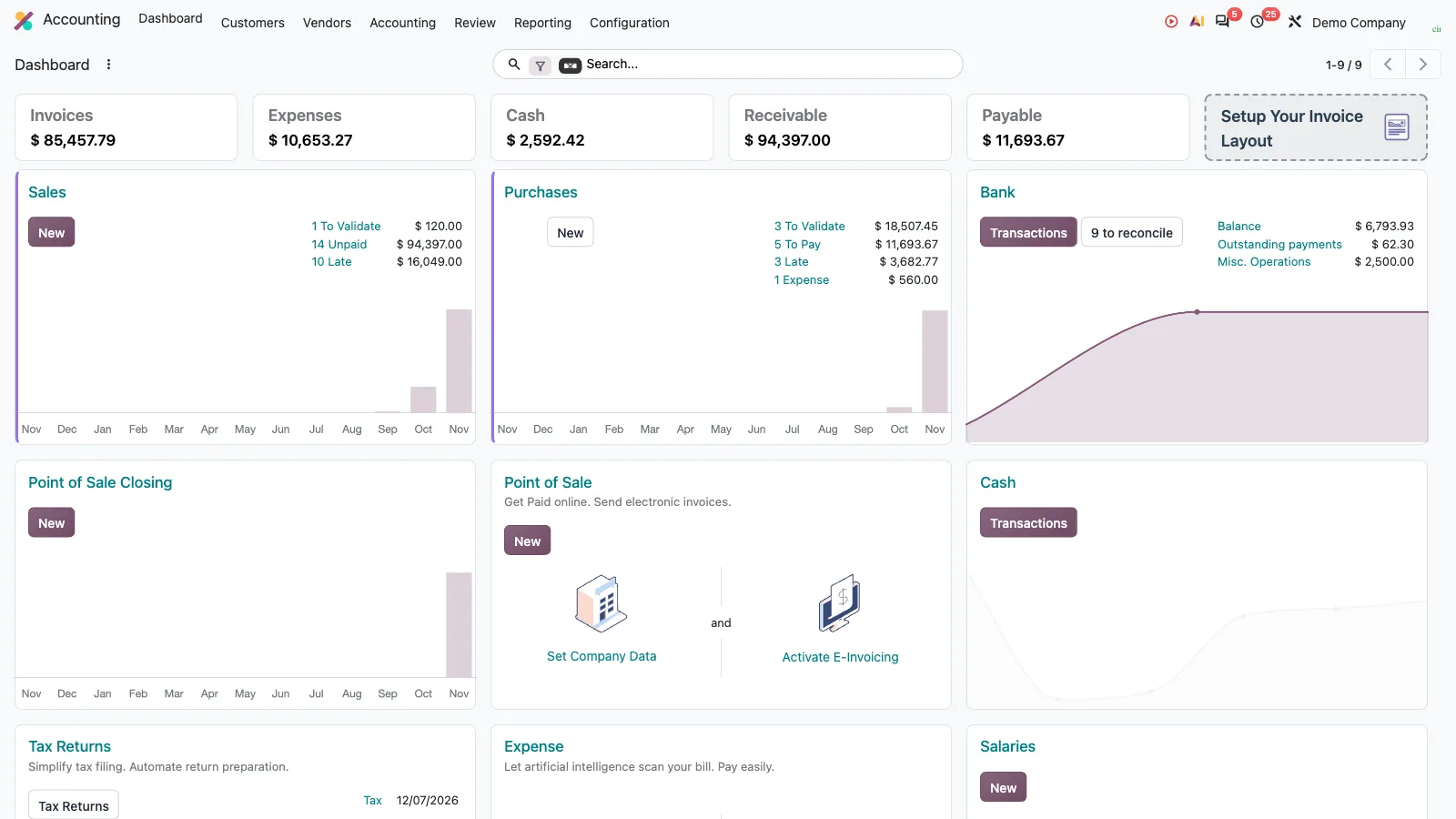
Odoo and Microsoft Dynamics 365 Business Central are the two ERPs UAE companies ask us to compare most. Both handle accounting, VAT, inventory, sales and purchasing well. The right choice depends less on features and more on how your company works.
Where Odoo is strong
- Breadth of apps: accounting, inventory, sales, purchase, manufacturing, HR, CRM, POS, website and eCommerce in one platform.
- Start small: companies can begin with a few apps and add more later.
- Flexibility: screens, reports and workflows are easy to adapt with Odoo Studio or development.
- Retail and POS: built-in point of sale that updates stock and accounts live.
Where Business Central is strong
- Microsoft 365: works inside Outlook, Excel and Teams – familiar for finance teams.
- Finance depth: strong dimensions, approvals and audit trail.
- Power BI: close integration for management reporting.
- Licensing tiers: Essentials, Premium and low-cost Team Member licences for occasional users.
Typical UAE scenarios
A trading company with 25 users, two warehouses and a free zone entity usually needs strong inventory, landed cost, multi-currency purchasing and multi-company accounting. Both ERPs handle this; the decision often comes down to whether the team already works in Microsoft 365 every day.
A retailer with five shops and an online store benefits from having POS, eCommerce, inventory and accounting in one system, which is a natural fit for Odoo.
A services or projects company that bills time and expenses and reports by project and department will find job costing and dimensions in Business Central, and projects and timesheets in Odoo – compare how each handles your billing rules.
Hosting and updates
Business Central is most often used as a cloud service hosted by Microsoft, with regular automatic updates. Odoo is available as Odoo Online, on Odoo.sh or installed on your own or a cloud server, which gives more control over customisation and update timing. Companies with strict data or integration requirements often weigh this point heavily.
Implementation and support
Both ERPs succeed or fail on implementation quality, not on the software alone. Ask any partner for a fixed-scope proposal, a data migration plan, a training plan and UAE references in your industry. Check who will support you after go-live, and how quickly they respond.
A quick comparison
- Best for Microsoft-centric finance teams: Business Central.
- Best for companies wanting POS, website, HR and ERP in one: Odoo.
- Manufacturing: both – Business Central Premium or Odoo Manufacturing.
- Heavy customisation: usually faster and cheaper in Odoo.
Questions that decide it
- Are you a Microsoft 365 company? If finance lives in Excel and Outlook, Business Central fits naturally.
- Do you need POS, website or HR in the same system? Odoo covers these out of the box.
- How unique are your processes? Both can be customised; Odoo is usually faster to adapt.
- What is your three-year cost? Compare licences per user, implementation days and annual support – not just the first-year price.
UAE requirements both must meet
Whichever you choose, check UAE VAT returns, Arabic/English tax invoices, multi-company for mainland and free zone entities, and readiness for UAE e-invoicing from 2027.
Adept implements both – Odoo (Odoo Silver Partner) and Business Central – so we can show both with your own data. Book a side-by-side demo.