Emiratisation is now a twice-yearly deadline for many UAE companies. Private-sector companies with 50 or more employees must increase the share of UAE nationals in skilled positions by 2% every year – split into two 1% targets, one for each half of the year.
Why it matters now
The targets are cumulative. Each half-year adds another 1% on top of the previous level, so a company that falls behind once has to recover the old gap and meet the new target at the same time. For a company with 200 skilled roles, every 1% is two more Emirati employees – and fines are charged per unfilled position, every month.
What the 2026 targets mean
- Who: private-sector companies with 50 or more employees.
- Target: +1% Emiratis in skilled roles by 30 June and a further +1% by 31 December – 2% for the year.
- Penalty: from 1 July, firms that miss the first-half target pay AED 10,000 per month for each Emirati position not filled (AED 120,000 a year).
- Incentive: companies that exceed their targets can join the Emiratisation Partners Club, with up to 80% off MOHRE service fees and priority in government procurement.
Why spreadsheets fail here
The target is based on skilled roles, not total headcount, and it changes as people join and leave. A spreadsheet updated once a quarter will show the gap too late to hire. HR also needs to show that Emirati employees are genuinely employed – MOHRE takes legal action against “fake Emiratisation”.
Planning hires before the deadline
Hiring takes time. If you discover the gap in June, it is usually too late to recruit, onboard and register a new Emirati employee before 30 June. A simple plan helps:
- Calculate your target for both half-years at the start of the year.
- Agree which roles will be filled by UAE nationals and budget for them.
- Use the Nafis platform and recruitment partners early in each half.
- Track joiners and leavers weekly – an Emirati resignation can reopen the gap.
Keeping the evidence clean
MOHRE checks that Emiratisation is genuine. Keep each employee’s contract, job description, WPS salary payments and attendance in your HR system so you can show real employment at any time. HR software makes this an automatic by-product of everyday HR work instead of a scramble before an inspection.
What to track in your HR system
- Headcount by skill level and nationality, by entity and branch.
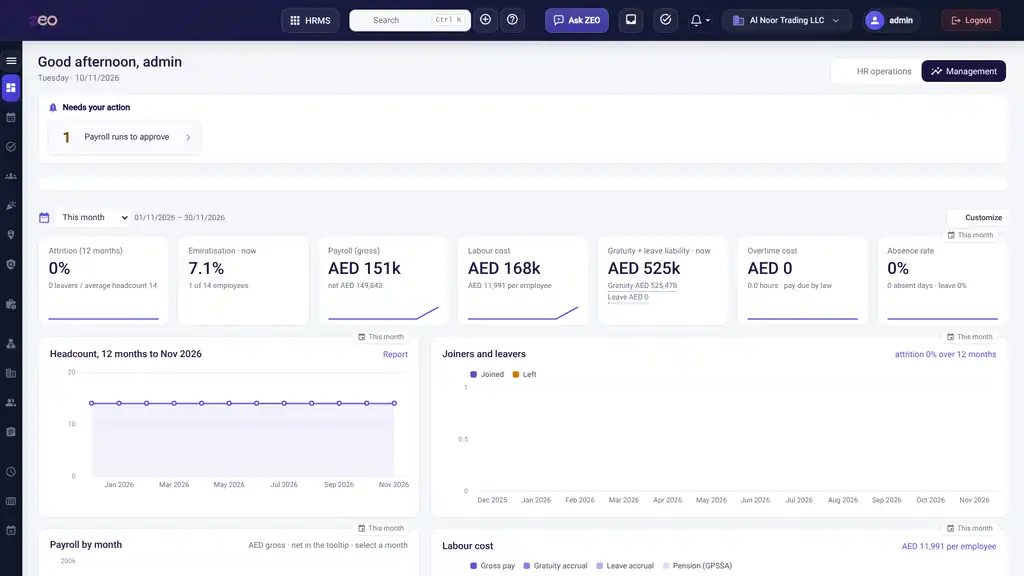
- Your required number of Emiratis for the current half-year and the gap today.
- Joiners and leavers that change the ratio, with alerts.
- Contracts, WPS salary records and attendance for each Emirati employee – the evidence of real employment.
HR software for UAE companies such as ZEO HRMS or Odoo HR can report this live, so HR and management see the position every week rather than at the deadline.
Frequently asked questions
Does Emiratisation apply to free zone companies?
The targets described here are set by MOHRE for private-sector companies under its jurisdiction; check with your free zone authority for your entity.
Is the target based on total employees?
It is based on Emiratis in skilled positions for companies with 50 or more employees.
Ask us for an HR dashboard that tracks your Emiratisation position.